Istwa Orijin lan
Miami Open for Business se te yon inisyativ pandan epòk pandemi an ki te vin posib grasa yon sibvansyon 20 milyon dola nan men Wells Fargo.
The pandemic laid bare the inequities that exist in small business entrepreneurship: while minorities and women are creating and growing businesses at a faster rate than their peers, they tend to have lower revenue and receive fewer loan approvals, among other challenges, all of which were worsened by the pandemic.
For this reason, Wells Fargo poured back into small businesses in five key cities across the country, including Miami – creating Miami Open for Business. Launched in 2021, this program had an explicit focus on asset-building and asset ownership to make small businesses (and nonprofits, which were also eligible to benefit from the program) more resilient and capable of building generational wealth.
Apwòch la
Pwogram nan te bay priyorite a pwopriyetè ti biznis ak lidè òganizasyon san bi likratif nan kominote espesifik nan Miami ki istorikman te neglije epi ki pa t resevwa ase envestisman. Nou te devlope de fason prensipal pou sèvi yo: lè nou ba yo finansman ak asistans teknik.
Pwodwi Finansye yo
Yo te distribye 15 milyon dola sou fòm twa pwodui finansye, apre yo te fin koute byen moun ki gen enterè nan kominote a ak ti biznis yo:
- The Technology and Equipment Microgrant: a grant of up to $20,000 that allowed entrepreneurs to invest in their business through the purchase of a technology asset or a piece of equipment, such as a pizza oven or pedicure chair.
- $3.8+ million distributed to 326 businesses and nonprofits
- Asset Building Loan for Entrepreneurs (ABLE): a low-interest loan that helped businesses and nonprofits buy inventory or a vehicle, remodel their property, or refinance predatory debt, among other purposes. Repayments will allow initial grant funds to be recycled into future community development projects.
- $4 million distributed to more than 60 borrowers
- Collective Real Estate Ownership (CREO): a fully forgivable loan of up to $500,000 to help small business owners and nonprofit leaders make a down payment on commercial real estate in a historically underinvested community. Properties had to be held in a collective ownership model with another business or organization to spur shared equity.
- $6.8+ million allocated to help close 14 deals housing almost 40 businesses and nonprofits, demonstrating the multiplier effect of collective ownership
Asistans Teknik
Miami Open for Business also empowered entrepreneurs with knowledge. Nearly $2 million was used to build a community of technical assistance providers across target communities in Miami who helped businesses apply for financing, organize their books, better understand marketing, and more. Technical assistance providers collectively provided over 1,000 businesses with more than 10,000 hours of assistance.
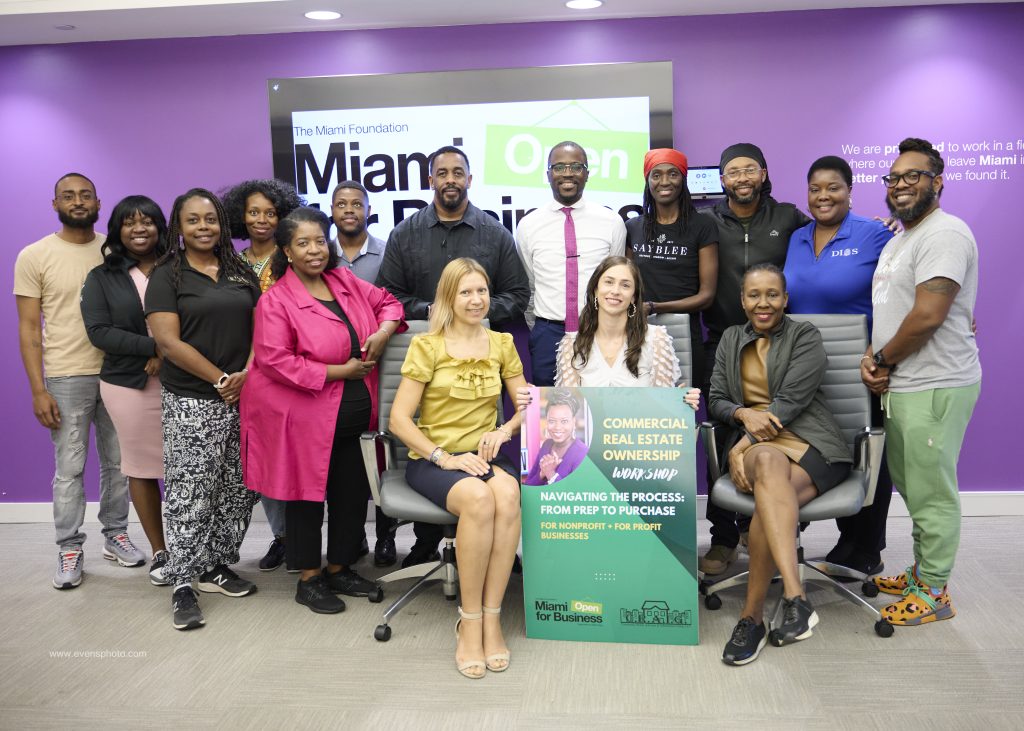
Apa pwogram asistans teknik la, Miami Open for Business te òganize tou yon seri atelye pou ti biznis, tankou sa yo konprann ki se premye atelye pou moun k ap achte byen imobilye komèsyal nan Sid Florid.
Enpak la
- 66% of the program’s beneficiaries were women-led organizations.
- 51% of funding recipients identified as Black. 50% identified as Latino, and 6% identified as Other.
Pwen Enpòtan pou 2024:
✅ Launched the STRIVE305 HUB alongside the Miami-Dade County Office of Innovation and Economic Development, an online hub for entrepreneurs
✅ Commissioned Catalyst Miami to conduct a comprehensive scan of national interventions that help businesses thrive to help inform the Foundation’s future activities
✅ Announced Miami Open for Business’ final round of ABLE loan recipients
✅ Closed 5 CREO small business real estate deals totaling $2.2M
✅ Hosted all-day small business resource festival, OFBPalooza, with over 170 attendees
Reflections from project lead Brittany Morgan, Senior Director of Economic Resilience (lightly edited for clarity):
“One of the proudest accomplishments was rolling out the commercial real estate product. We mirrored this product after the City of D.C. and efforts elsewhere. We were borrowing from the first-time homebuyer down payment assistance world. We knew that it was possible to help businesses and nonprofits own their own real estate… Not only did I learn a lot, but the folks who went through this program have learned a lot.
In fact, this learning has been so great that it’s inspired our Foundation to think about how we can invest in future community development projects. We’ve done several commercial deals now, but imagine a world in which we’re using our assets to help affordable housing projects get the financing that they need and helping entrepreneurs get different types of financing outside of a conventional loan. It’s really opened our eyes to the possibility of innovative finance.”
Leson yo te aprann – ak opòtinite yo te rekonèt:
- We learned the importance of providing culturally appropriate technical assistance, which is necessary to overcome digital and financial literacy challenges, along with language and cultural barriers.
- We learned the importance of working with trusted community-based partners; support is more accessible when it’s decentralized, and trusted partners helped us be nimbler and more innovative.
- Nou te rekonèt defi ki genyen nan navige nan byen imobilye komèsyal , espesyalman opsyon limite pou sipò finansye.
- We see an opportunity to build a regional philanthropic impact investing alliance where financial resources can be pooled in support of community development projects.