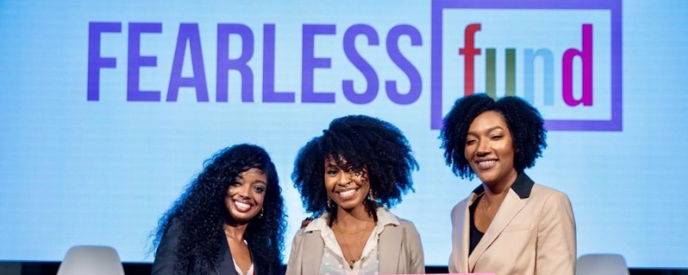
Photo credit: Fearless Fund & Mind Money Media Inc
Can a law that was created in 1866 to protect newly freed slaves be used to block racial equity efforts? Starting last week, it seems decidedly so.
Last week, the U.S. Court of Appeals for the Eleventh Circuit blocked the Fearless Fund from investing in Black female entrepreneurs, on the grounds that it is racially exclusionary and thus likely violates federal law. A decision like this has massive consequences. Those of us who run foundations, scholarship programs, investment funds, and even summer internship programs must figure out how we continue pursuing racial equity in the face of new restrictions. Nonprofits need to figure out how to continue to serve the communities where they work without fear of repercussions, and donors need to find new ways support the causes they most care about.
It is not a coincidence that this is happening on the heels of this year’s Supreme Court decision overturning affirmative action. Three nonprofits founded by the same leader are working toward this common goal of attacking race-based decision-making in the United States – Students for Fair Admissions, focused on reversing affirmative action; The American Alliance for Equal Rights, focused on suing programs that consider race in their processes; and Project on Fair Representation, a nonprofit legal defense fund that supports lawsuits that are challenging racial discrimination issues on the state and federal level.
At the core, this is a debate about what’s fair and just in 2024. Those who oppose affirmative action and investment programs that prioritize historically disadvantaged minority groups would argue that it’s simply not fair to give an advantage to any racial group. We would never allow an investment firm to host a “whites only” grant program – how could we allow for a “Blacks only” program?
I wish it were that simple. The data demonstrates that racial inequities still perpetuate massive disadvantage for minority business owners. Higher mortgage rates. Lower property valuations. Lower rates of loan approvals. Lower rates of mentorship. Decreased likelihood for generational wealth to help kickstart their projects. And of course, in an environment where investors are more likely to find affinity in entrepreneurs who “remind them of themselves”, there are very few minority investors.
Only 2% of venture capital currently goes to Black business owners – less than half of that to Black women. Programs like the Fearless Fund exist explicitly to overcome the inequities remaining in the marketplace. While all of us surely wish to live at a time when there are no racial disparities, and where there should be no need for any special programs to address racial gaps, the data is clear – we’re not there yet.
But in light of this week’s decision, it just got even harder for those institutions trying to address racial inequity. Here in Miami, we see racial disparities across nearly every issue area from maternal health outcomes to academic attainment to access to general operating dollars for nonprofit leaders. As we work to build a Miami where everyone thrives, we must continue to prioritize solutions led by leaders closest to the issues themselves, and to look closely at racial inequities to drive our strategy.
For those looking toward solutions, below are four actions to consider:
1. Be precise in your language.
If you cannot build a program explicitly for one group of people who face a specific gap, then what is allowed? If scholarship programs cannot prioritize racially marginalized groups, can they use zip codes as a proxy? What other criteria could honor the same intent? If the new law says contracts are problematic, what other ways can investment programs officialize relationships and make investments? Let us become experts in what is possible.
2. Double down on the data.
The numbers don’t lie, and it’s easier to advocate for solutions when the problems are crystal clear. Lift up the data in your community and invite solutions from people of all backgrounds. This decision seeks to prevent investment decisions based on the leader’s race. But it is allowable for someone to invest in solutions that address inequity. As we look to invest in bold solutions for racial inequities in our community, we often see that those closest to the issues themselves are poised with the most powerful and effective strategies. Use the data you have to invest in those closest to the work. Note: I’ve included links below to some of the data sources I’ve been leveraging, as we deepen our commitment to both minority-led businesses and nonprofits.
3. Collaborate.
Partnership is more important than ever. If you’re not willing to act alone out of fear of being targeted or of taking a misstep, stand together. Find others who share common goals. Join larger efforts that are likely searching for increased partnership right now. At The Miami Foundation, we launched our Racial Equity Fund in 2020 and found that many of our earliest partners were thankful not only to invest in racial equity, but to stand together.
4. Learn, borrow, repeat.
We cannot afford to work in silos in each of our communities, recreating the same wheel. If one community finds a solution, others should immediately learn from, borrow, replicate, and build upon that strategy. If you see something that is working, please reach out. And if we’re doing something that could benefit your community, leverage it.
Do not be scared to lead when others freeze in motion. In the absence of moral clarity, shine your light more brightly.
DATA :
Small Business Administration (SBA) – Office of Advocacy: In the Small Business Administration’s 2020 report, Black-owned businesses were about half as likely to be approved for loans as their white counterparts. In 2019, only 29% of minority-owned businesses had their loan applications approved compared to 60% for non-minority-owned businesses.
Federal Reserve Banks – Small Business Credit Survey: The 2021 Small Business Credit Survey found that 43% of Black-owned firms and 41% of Hispanic-owned firms reported being discouraged from applying for credit because they believed they would be turned down, compared to 30% of white-owned firms.
The same survey found that 13% of Black-owned firms received all their sought financing in the previous year, compared to 40% of white-owned firms.
Kauffman Foundation – Entrepreneurship Research: The Kauffman Foundation’s 2021 report on entrepreneurship noted that Black entrepreneurs received less than 1% of venture capital investment annually, a stark contrast to the percentage of Black individuals in the overall population.
The rate of new entrepreneurs for Black Americans was 0.24% in 2020, lower than the 0.38% for white Americans, indicating disparities in entrepreneurship rates.
National Minority Supplier Development Council (NMSDC): NMSDC reported that MBEs face a significant gap in access to corporate and government contracts. While MBEs make up approximately 29% of all U.S. businesses, they only account for 11% of all corporate procurement spending.
Brookings Institution – Metropolitan Policy Program: A 2020 Brookings report highlighted that minority-owned businesses have a higher likelihood of being located in low-income areas with limited access to resources and capital. Black and Latino business owners are more than twice as likely to have their loan applications denied compared to white business owners.
Center for Responsible Lending (CRL): The CRL’s 2019 report showed that Black and Latino business owners were significantly more likely to be subjected to predatory lending practices, with higher interest rates and less favorable loan terms.
PitchBook Data: According to PitchBook’s 2022 data, Black startup founders received just 1.2% of the $147 billion in venture capital invested in the first half of 2021, highlighting the stark underrepresentation in access to venture funding.